
Second Conversation Report on Climate Change in Bhutan: Impact and Responses
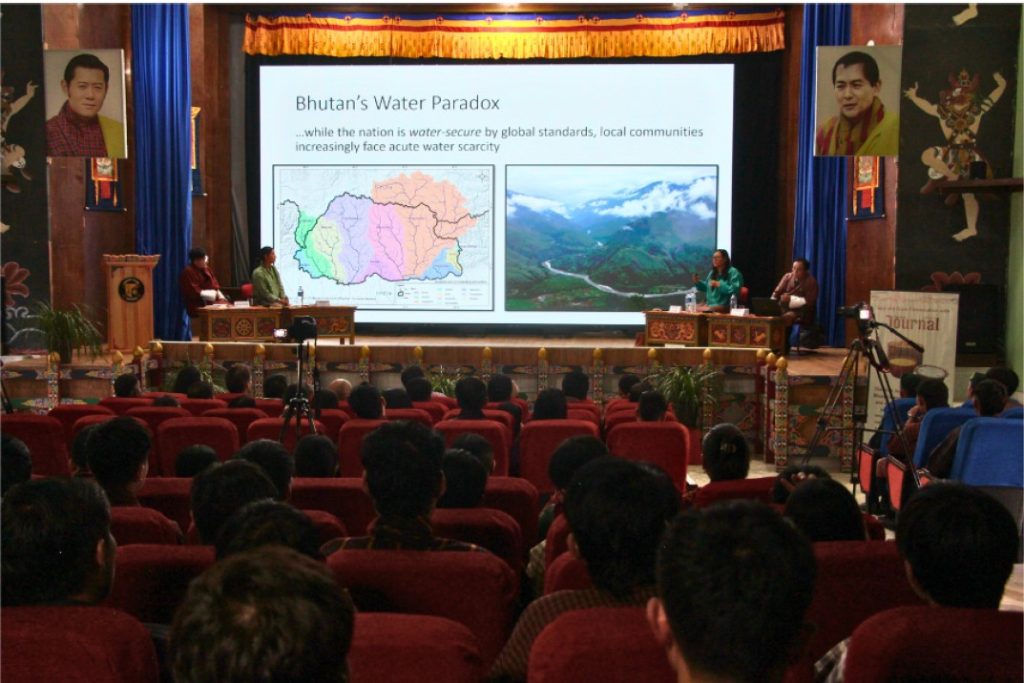 Climate change is a reality and all Bhutanese must be more aware of its challenges to the country’s sustainability, and work to influence stronger climate action in Bhutan. This was a message from a Suja and Dzaw Conversation centred on The Druk Journal’s latest edition with the theme Climate Change in Bhutan: Impact and Response. There is also a need for more research and systematic analysis of climate change and the environment to make good decisions for Bhutan’s climate responses.
The conversation took place on 15th August 2025 at Sherubtse College, Kanglung, Tashigang. More than 120 participants – including former Members of Parliament to students, teachers, lecturers, district and gewog officials – reflected on Bhutan’s climate challenges and collective responses.
Four contributors to this edition shared key perspectives from their articles: Sonam P. Wangdi (Former Secretary, National Environment Commission), Sonam Choden (Lead Research Coordinator, ReBuilt Bhutan.), Pema Eden (Ph.D. candidate, College of Natural Resources), and Kinley Dorji (Lecturer, Royal Thimphu College). The conversation was moderated by the Journal’s editor, Dasho Kinley Dorji.
Speaker Highlights
Speaker 1
Climate negotiator, Sonam P. Wangdi, highlighted Bhutan’s engagement in global climate negotiations under the UNFCCC, Kyoto Protocol, and Paris Agreement, stressing the central target of limiting warming to 1.5°C, a goal strongly championed by Bhutan and other LDCs. He emphasised that climate finance—critical for adaptation and resilience—remains grossly inadequate, forcing developing countries into debt as they address disasters like floods. While national capacity to access funds is improving through agencies like the Bhutan Trust Fund gaining accreditation, Bhutan still faces immense challenges from climate change, including glacial melt, drying springs, and the risk of glacial lake outburst floods.
With Bhutan no longer an LDC, competition for funds is tougher despite growing national capacity to access them. He said that Bhutan faces severe risks from glacial melt, drying springs, and floods, and urged that climate change must be demystified so the public can influence democratic and political processes to push for stronger climate action.
Speaker 2
Researcher, Sonam Choden, highlighted Bhutan’s paradox of being water-rich yet water-insecure, as rivers lie deep in valleys while settlements rely on fragile springs. She noted that drying water sources are not only due to climate change but also human interventions and poor infrastructure. Major threats include glacial lake outburst floods, flash floods, and drying springs. She stressed localised water management, prioritising surface water, stronger governance, and long-term monitoring. The speaker emphasised how perceptions shape behaviour: if water is seen as limited, people act to secure it, whereas thinking it is unlimited leads to waste; glacial lakes, she said, are like a “fixed deposit” for our future that is diminishing. She questioned whether informed decisions are being made, pointing out a lack of communication and coordination, and underscored the importance of raising awareness so that Bhutanese, especially youth, understand water sources and treat water as a finite resource.
Speaker 3
Phd candidate, Pema Eden, highlighted the critical role of Bhutan’s cryosphere—glaciers, snow, ice, and permafrost—in water security and climate resilience. She emphasised that glacier retreat and glacial lake outbursts are accelerating, posing serious risks to downstream communities and infrastructure, and noted that Bhutan’s carbon-negative status and conservation efforts do not eliminate these hazards. She also connected permafrost thaw to slope instability and potential impacts on cordyceps habitats, illustrating how environmental changes affect both ecosystems and livelihoods. The speaker stressed the need for robust data, scientific evidence, and storytelling to communicate these challenges effectively, urging citizens to be actively involved in both understanding and addressing climate impacts.
Speaker 4
A lecturer on the environment and Phd candidate, Kinley Dorji, highlighted how climate change is experienced and interpreted in Lhuntse through an ethnographic lens. Using local stories and seasonal practices, he showed that the community in Lhuntse perceives climate change not only as environmental shifts, but also as disruptions to sacred cycles and ancestral knowledge. Unpredictable rainfall, flash floods, and altered planting and harvesting rhythms are understood as breaks in the balance between people, land, and spiritual forces. Traditional rituals and offerings remain central to coping and adaptation, reflecting a deep connection to the land and ecological understanding. The speaker emphasised that resilience in Bhutan draws on both cultural wisdom and practical strategies. He suggested that stories can give climate change a human face, helping people to understand, feel, and imagine a better future citing Deborah Bird Rose and Sophie Chao’s insight that humans hold multiple imaginations. Hence, he stressed the importance of reaching out to youth and individuals so that everyone can understand and appreciate the urgency of mitigation and adaptation.
Comments from the discussions:
● Are Bhutanese youth aware of the relationship between nature and people or is this sensitivity fast disappearing citing the case of Lhuntse and other places?
● There’s adequate surface water but a lack of clear decisions based on scientific research. Hence decisions are sometimes made in the absence of data.
● The conversation pointed out the huge potential in the power of young minds to address Climate Change and the future. The younger generation may be the future of the world in terms of Climate mitigation, adaptation, and the environment.
● Noting unchecked resource consumption, the conversation talked about giving a face to Climate Change through stories. CC is known as a “crisis of imagination”. Bhutan can imagine a good future. With that imagination, can we give a face to CC, through what BCMD and The Druk Journal is doing here with conversations and through stories. Capitalism is an imagination – We know the symptoms.
● Apart from the millions of Ngultrum needed for climate change adaptation and mitigation approaches, what can people do at the local level?
● Despite Bhutan’s reputation as a carbon negative nation, the visible impacts of climate change such as glacial retreat, flooding, and unpredictable seasons raise the urgent question of whether the nation, its leaders, and policies are truly prepared to confront this looming crisis.
Way Forward
● Strengthen climate adaptation strategies through practical solutions in water management, agriculture, and disaster preparedness.
● Promote integrated water resource management, including sustainable use of surface water, groundwater, and rainwater.
● Enhance policy and governance by enforcing environmental regulations, clarifying resource ownership, and integrating climate adaptation into development planning.
● Increase youth engagement and education in climate discussions and initiatives.
● Integrate cultural and ethical approaches, emphasising moderation, contentment, and harmony with nature.
● Adopt system-level approaches to address interconnected environmental, social, and economic issues.
● The government, civil society organisations, schools can do more to promote and develop people’s awareness of climate change – its impact and Bhutan’s responses.
Recommendations
● Implement technology and forecasting tools to anticipate and respond to climate risks.
● Monitoring the situation is just as important as having the policies. Encourage more research and systems analysis.
● Regulate water extraction and improve infrastructure and water quality monitoring. For example, Bhutan has enough surface water but we’re not managing it well and are now extracting ground water which can be more “disastrous” in the long term especially for villages downstream.
● Promote interdisciplinary learning and critical thinking among youth on environmental challenges.
● Foster mindful consumption such as plastic water bottles and ethical decision-making at the community and individual levels.
● Encourage collaboration between scientists, policymakers, and communities for data-driven solutions.
● Advocate for shared responsibility and global cooperation on climate change. Keep advocating and grooming the younger generation.
● Talk about Climate Change as Stories, so people can feel it and to make it come alive through education. Learn to listen not just to people, but to all lifeforms as well.
Feedback and Testimonials on the Conversation
“We did learn about climate change from a very young age in our school, but through this conversation we get to learn more about how spiritually local peoples are affected, and how they think of climate change.We usually think of climate change in terms of increasing temperature, and now through this conversation we talk more about how climate change is affecting water
glaciers. If we think for the short term, I think due to climate change, increasing temperature and melting of glaciers, positively it might have few benefits for hydropower. But in the long term, because of this melting of glaciers and all, I think sustainability will be very hard…but as forestry personnel, we are doing everything we can to make sure that forest coverage is higher carbon sequestration and positively contributing towards climate change.”
Kelzang Jigme
Forest Division, Tashigang.
“My takeaway from the presentation is that I learned that climate change is not only a one-person problem, but a global disaster, because climate change can cause disasters such as GLOF, which causes people to lose their homes, their family, and their determination to live. To fight such problems, we all have to work together as a huge global family so that we can achieve the visions and goals of a wise king, as one of the pillars of GNH is conservation of environment. This pillar gives us a future where we can live happily and with harmony with nature. This is the vision and goal of a wise king.”
Pema Tenzin Dorji
Student, Jampeling School
This edition of The Druk Journal and the Conversation were made possible with support from the Karuna Foundation and the Bhutan Foundation.
We acknowledge the support from Sherubtse College for co-hosting the Conversation att the Sherubtse College, 15th August, 2025.