
First Conversation Report on Mindful Governance, Mindful Society
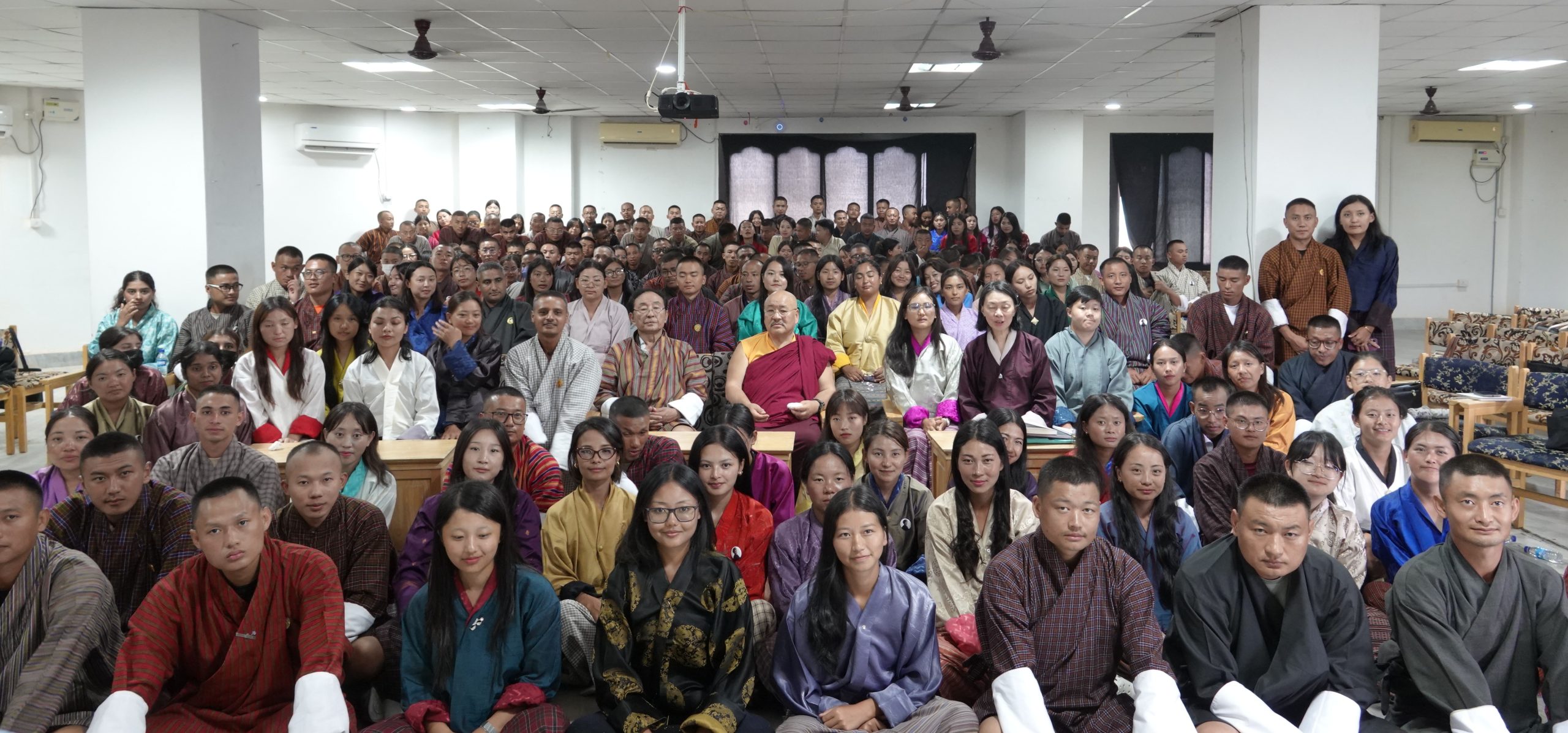
The Suja and Dzaw Conversation followed The Druk Journal’s latest edition with the theme Mindful Governance, Mindful Society.The conversation took place on 30th October 2025 at RRCO hall, Gelephu, with 230 Pelsups, a diverse group of students, graduates, early-career professionals, entrepreneurs, civil servants, and private sector actors, to explore mindfulness in Bhutanese society – spirituality and governance. The discussion drew on insights from the featured article, which included qualitative research interviews with a cross-section of Bhutanese society, offering grounded perspectives on how mindfulness is understood and practiced across different walks of life
The session was moderated by Dasho Kinley Dorji ( Editor, The Druk Journal) and featured four speakers who contributed articles to the issue: Ven.Lungtaen Gyatso (President, College of Language and Cultural Studies, RUB), Dr. Joel and Michelle Levey (Founders, Wisdom at Work), Phub Dem (Doctoral Student, Nagoya University, Pelsup participant). They shared key insights from their articles. Siok Sian Pek-Dorji (Advisor, BCMD and Editorial Member, The Druk Journal) also shared her views.
Speaker Highlights
Speaker 1
Ven. Lungtaen Gyatso highlighted the significance of mindfulness and awareness as foundational mental qualities in Buddhism, emphasising their complementary roles in fostering insight, well-being, transformation, and liberation. He traced the growth of mindfulness from its 2,500-year-old Buddhist roots to its contemporary global popularity, noting the surge in research, digital interest, and practical application across education, corporate settings, military, and sports. He explained that true happiness primarily arises from within, shaped by right thoughts, feelings, and emotions, rather than external conditions like wealth or status. Mindfulness, defined as sustained attention to our thoughts, emotions, and feelings, and awareness, as the clear perception and understanding of these experiences, allow individuals to manage their reactions, reduce negativity, and respond to the world with compassion. Ultimately, he emphasised that cultivating mindfulness and awareness is essential for personal well-being and the full development of human potential.
Speaker 2
Dr. Joel and Michelle Levey emphasised that mindfulness, rooted in the teachings of Shakyamuni Buddha, is essential for discerning the right livelihood and cultivating wisdom that benefits others without causing harm. They highlighted how mindfulness opens the eyes to see things as they truly are and aligns with the vision of Gelephu as a “Mindfulness City” prioritising sustainable and ethical development. Drawing on the history of mindfulness in the West, they noted how early Western adaptations often separated mindfulness from its ethical, spiritual, and compassionate foundations, reducing it to stress reduction or performance enhancement. In contrast, Bhutan has the unique opportunity to maintain the integrity of mindfulness teachings, integrating Bodhicitta, altruism, and ethical purpose into daily life and civic culture.
They also noted that mindfulness principles have been successfully applied in global contexts, including Fortune 500 companies, parliaments, and international organisations, showing how sacred practices can be meaningfully integrated into secular, high-performance environments. They emphasised that mindful prosperity is guided by motivation and intention, and that mindfulness practised with compassion and presence can transform everyday actions, relationships, and communities while inspiring the world with Bhutan’s holistic approach.
Speaker 3
Phub Dem invited innovators to critically assess their ideas, using a waste to energy example to illustrate that seemingly sustainable solutions can merely transfer pollution or social costs and urged the redesign of business models with genuine social and environmental care. The speaker asked participants to evaluate ideas from three angles: how they position GMC among global city models, how they translate and personalise GNH philosophy, and how they can globalise a mindfulness approach internationally. Highlighting that contemporary city models are often market centric and frequently duplicated from abroad, she encouraged contextual, people centred, value driven adaptations that integrate green tech, agri tech and other innovations so GMC can become a balanced, holistic urban model with mindfulness at its centre and aligned with ecological ceilings and social foundation thresholds. The speaker concluded by recalling His Majesty’s call for collective effort and shared vision and urged Pelsups to collaborate to make GMC’s mindful urban aspiration a reality.
Speaker 4
Siok Sian Pek Dorji highlighted that mindfulness in Bhutan extends beyond meditation to everyday governance and social life, noting its presence in schools and parts of the civil service. The speaker drew attention to the history of Engaged Buddhism, where practitioners applied mindful practice to social and political issues, and cautioned against reactive quick fixes to challenges, and the implementation gap between policy and practice, illustrated by an example of a poorly ventilated tunnel that never received adequate follow-up to achieve it’s original planned standard. She quoted respondents who were asked to share their views on Mindfulness in her article. One respondent , an economist, cautioned that some projects’ original intentions might be compromised by hasty implementation, and respondents urged better feedback loops so decisions can be more reflective and accountable. Others observed a dharma disconnect whereby secular, Western repackagings of mindfulness sometimes feel more accessible than native spiritual practices. The consensus was that spiritually insightful, consultative, and co-creative governance can strengthen Bhutan’s approach, and while Gelephu Mindfulness City was recognised as a timely and skillfully designed initiative, it will benefit from further deliberation and collective effort to ensure it truly trains minds for the benefit of communities.
Comments from the discussions
- Mindfulness should extend to environmental consciousness, ensuring that development in Gelephu Mindfulness City preserves biodiversity and cultural significance.
- ‘Commercialising’ mindfulness could help sustain mindfulness education and practice, as people tend to value initiatives more when there is some investment or cost attached. Initiatives need to be sustained hence, participants raised the question of ‘commercialising’ or getting some contributions for such programmes.
- Spiritual and community institutions should take the lead in promoting mindfulness, supported by local engagement and business collaboration.
- There is a need to balance spiritual principles with economic and technological innovation to achieve mindful prosperity. Mindful prosperity is prosperity that serves the common good.
- Some participants raised philosophical and ethical questions about the nature of mindfulness, such as whether “ignorance is bliss” and how awareness can coexist with global suffering.
- Young participants expressed inner conflict about finding peace in a world filled with conflict, reflecting the need to link mindfulness with compassionate action rather than detachment.
- Awareness of mindful prosperity as a goal, where mindfulness contributes to economic, social, and environmental well-being, was emphasised
- Questions arose about objective versus subjective measures of mindfulness, similar to discussions on Gross National Happiness indicators, and how innovations could incorporate measurable mindful impact.
Way Forward
- Encourage integration of mindfulness into all levels of planning and development in Gelephu Mindfulness City, ensuring ecological and cultural preservation.
- Explore structured models for mindful commercialisation, such as social enterprises or community-led initiatives that balance profit with purpose.
- Support innovation like digital platforms that promote civic engagement and sustainable living through mindful incentives.
- Maintain a strong spiritual foundation in GMC’s growth in Bhutan while welcoming collaboration with professionals and institutions to balance values and expertise.
- Strengthen education and awareness on mindfulness as a lived practice rather than a conceptual ideal.
- Incorporate objective indicators in measuring mindfulness and well-being to complement subjective reflections under the GNH framework.
- Promote collective effort and collaboration between spiritual leaders, civil servants, private sector, and communities to realise GMC’s vision of mindful prosperity.
Good reading, good thinking and good conversation
The conversation resulted in a lively discussion and has the potential to deepen the understanding of mindfulness and how to be more intentional in integrating mindfulness into the functioning of governance and society. The Druk Journal continues to share the questions and comments raised on its social media presence for more deliberations and invites the Pelsubs and readers to keep reading, thinking and conversing about mindful governance, mindful society.
Feedback and Testimonials on the Conversation
“The session was truly enriching. I was inspired by the curiosity and genuine concern shown by everyone. With this level of awareness and commitment, I am confident that Pelsups will meaningfully contribute to GMC’s development.”
Phub Dem
Pelsub participant
“This conversation was really helpful because it moved my understanding of mindfulness from a general idea to a more concrete and actionable concept. I used to think mindfulness was just about clearing your mind and that mindfulness only applied to formal sitting sessions, but now I realise it’s more about observing your thoughts without judgment and I gained value from the discussion on micro-mindfulness, the ability to apply awareness to mundane daily tasks like doing the dishes or walking to the car.”
Sonam Tandin Phurba
Participant from the Pelsung programme
This issue Mindful Governance, Mindful Society features 17 articles by 24 writers. Find all the articles on https://drukjournal.bt/mindful-governance-mindful-society/
This edition of The Druk Journal and the Conversation were made possible with support from the Bhutan Foundation.