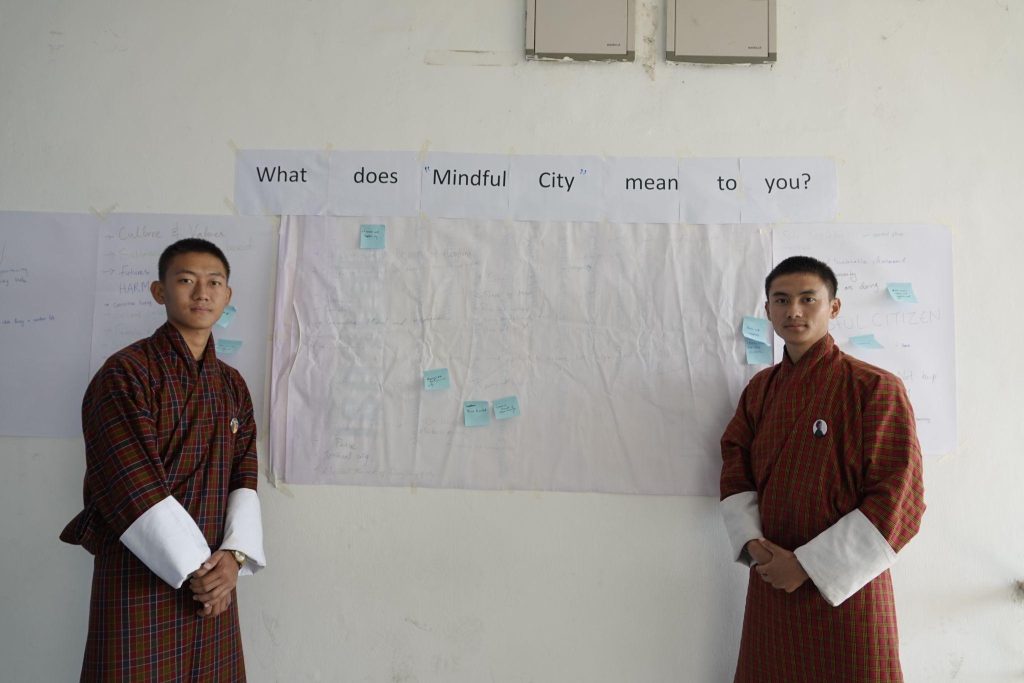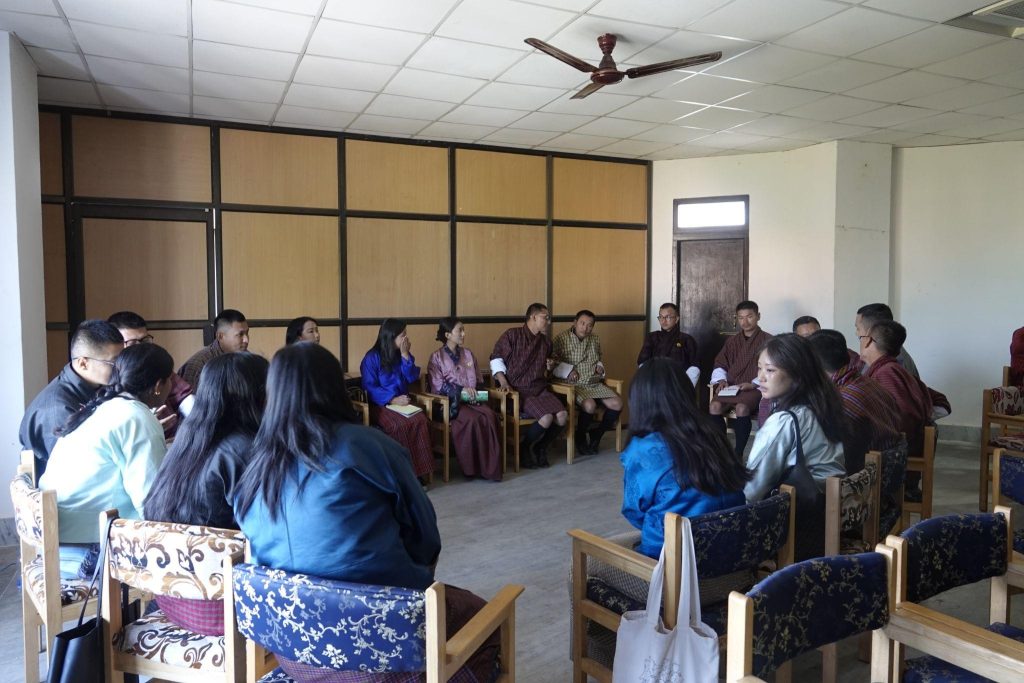
Conversation Report on Mindful Governance, Mindful Society
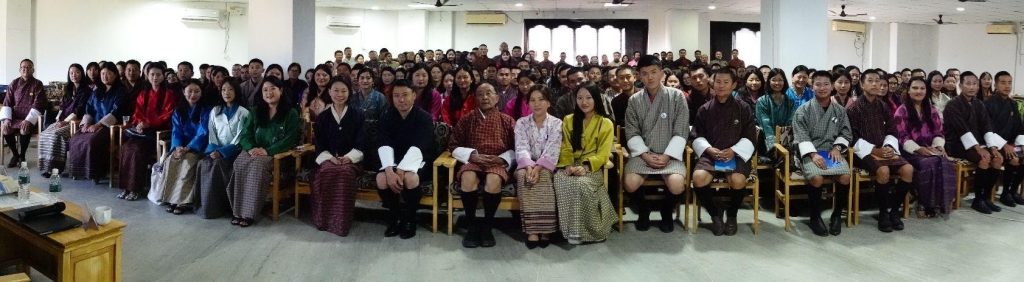
Second Conversation held at the RRCO Hall in Geylephu with the second cohort of the Pelsup programme.
The second Druk Journal Conversation on the 22nd edition themed Mindful Governance, Mindful Society, was held on 8th January 2026 at RRCO Hall, Gelephu, from 9:00 AM to 12:50 PM, with 348 Pelsups participating. The session brought together a diverse group of students, graduates, early-career professionals, entrepreneurs, civil servants, and private sector actors to explore mindfulness in Bhutanese society and governance.
The discussion drew on insights from the featured articles, which included research and grounded perspectives on how mindfulness is understood and practiced across different walks of life. The session was moderated by Dasho Kinley Dorji, Editor of The Druk Journal, and featured four speakers: Dr. Joel and Michelle Levey (Founders, Wisdom at Work and researchers in contemplative science), Ven. Lungtaen Gyatso (President, College of Language and Cultural Studies, RUB), Tenzin Leewang (former Drangpon and Chief Administrator at the Bhutan Alternative Dispute Resolution Centre), and Siok Sian Pek-Dorji (Advisor, BCMD and Editorial Member, The Druk Journal), who shared key insights from their respective articles.
Speaker 1
Article: Mindful Prosperity and Right Livelihood by Dr. Joel & Michelle Levey
Dr. Joel and Michelle Levey presented a global perspective on mindfulness rooted in the teachings of the Buddha, while tracing its spread and reinterpretation in Western societies. They cautioned against modern adaptations that detach mindfulness from ethics, compassion, and wisdom, reducing it to stress management or performance enhancement. Emphasising right livelihood and interdependence, they argued that mindfulness should guide intentions and actions so prosperity benefits others without harm. Drawing on examples from corporations, parliaments, and international institutions, they demonstrated how mindfulness can inform leadership and decision-making in secular contexts. They noted that Bhutan, and particularly Gelephu Mindfulness City, has a unique opportunity to model mindful prosperity grounded in altruism, ethical purpose, and long-term collective well-being.
Speaker 2
Article: Mindfulness and Awareness in Buddhist Thought, Ven. Lungtaen Gyatso
Ven. Lungtaen Gyatso explained mindfulness and awareness as foundational and complementary mental qualities in Buddhism, essential for insight, emotional balance, and liberation from suffering. He described mindfulness as sustained attention to thoughts and emotions, and awareness as the clarity that understands these experiences, enabling wise and compassionate responses. Tracing mindfulness from its 2,500-year Buddhist origins to its contemporary global popularity, he highlighted its expanding application in education, research, corporate environments, the military, and sports. He emphasised that true happiness arises primarily from inner mental states rather than external conditions such as wealth or status, and that cultivating mindfulness and awareness is central to personal well-being and the full development of human potential.
Speaker 3
Article: Nangkha Nangdrik, Foundation of Mindful and Sustainable Civil Justice System by Tenzin Leewang
Tenzin Leewang framed mindful governance through the Bhutanese tradition of Nangkha Nangdrik (mediation), presenting it as a compassionate, people-centred approach to justice rooted in Buddhist values. He explained that conflict often stems from emotional imbalance, ego, and misunderstanding, and that mediation addresses these root causes by fostering empathy, dialogue, and mutual respect rather than adversarial competition. Unlike litigation, which produces winners and losers, mediation focuses on repairing relationships, creating future-oriented solutions, and sustaining long-term peace. Drawing on historical precedents and recent case data, he demonstrated how mediation reduces judicial burden, preserves social harmony, and aligns the justice system with Gross National Happiness principles.
Speaker 4
Article: Mindfulness in Bhutanese Society and Governance: People’s Perceptions by Siok Sian Pek Dorji
Siok Sian Pek Dorji highlighted mindfulness as a practical necessity in governance, planning, and everyday social life, using Gelephu Mindfulness City as an example of long-term, people-centred decision-making. Drawing on interviews with entrepreneurs, investors, educators, civil society actors, artists, and policymakers, she pointed to gaps in mindful planning, consultation, and feedback mechanisms, as well as social challenges such as alcohol misuse, littering, and civic disengagement. She cautioned against extracting mindfulness from its dharmic foundations and reducing it to individual well-being or market utility, emphasising instead interdependence and collective well-being as the motivation for a mindful society. Stressing co-creation over top-down approaches, she called for development that balances economic goals with wisdom, care, and shared societal benefit.
Comments from the Discussion
- Participants asked if mindfulness can be measured objectively, drawing comparisons with the indicator-based approach used in GNH.
- Mediation uptake such as the proportion of disputes resolved outside courts, was discussed as a possible indicator of mindful governance.
- Concerns were raised about how Gelephu Mindfulness City (GMC) can ensure fairness, social trust, and long-term prosperity in both formal and informal systems.
- There was agreement that mindfulness should be operationalised, not left as an abstract or symbolic concept.
- Clarity was sought on how making profit affects one’s peace of mind – how can investors/ business entrepreneurs be mindful in business?
- Participants cautioned against forms of mindfulness that are detached from ethics and compassion, reduced to productivity or stress-management tools.
- The importance of mediation as a relationship-preserving, people-centred approach to resolving conflict was emphasised.
- Legal questions were raised about whether Bhutan’s dispute resolution framework is adequate for international and commercial contexts, with implementation noted as a key gap.
- Participants highlighted emerging risks from technology and AI, including digital fraud, deepfakes, and intellectual property concerns.
- Concerns were expressed that rapid urbanisation in GMC could weaken local feedback loops and access to community-based justice.
- Participants discussed how youth engagement in agriculture could be reframed as meaningful and viable entrepreneurship.
- Social challenges such as alcohol misuse, littering, forest fires, and civic disengagement were repeatedly cited as the need for society to be more mindful about.
- Many participants stressed the lack of systematic consultation and feedback mechanisms in policy development.
- Ethical questions were raised about whether conventional capitalist models align with the values of mindful prosperity. The group discussed the need to explore the models of economic development including those that focus on community investments and enterprises etc.
- Questions emerged around reconciling investment and economic growth with peace of mind and collective well-being.
- The role of parents, educators, and media in shaping responsible technology use and civic values among young people was emphasised.
Way Forward and Recommendations
- Develop a pilot framework for measuring mindfulness, drawing from the GNH domain and indicator approach.
- Use mediation statistics as a governance indicator to assess trust, social harmony, and access to justice.
- Strengthen alternative dispute resolution infrastructure within GMC through training, accreditation, and local access points.
- Focus on implementation and capacity-building for existing dispute resolution laws rather than new legislation.
- Articulate a Mindful Prosperity framework to guide investment and business practices based on intention, ethics, and social benefit.
- Support youth-led and community-based enterprises, particularly in agriculture, green technology, and value-chain innovation.
- Integrate mindfulness education across school curricula, linking awareness to civic responsibility and ethical decision-making.
- Establish regular consultation and feedback platforms, both digital and in-person, for policy and planning processes in GMC.
- Build institutional capacity to address technology-related risks, including AI misuse and digital evidence management.
- Adopt long-term planning horizons for education, justice, and civic infrastructure to avoid short-term, reactive decisions.
- Promote community-based mediation models accessible to diverse populations, including migrants and investors.
- Launch public awareness initiatives on civic care, environmental responsibility, and social well-being.
- Provide targeted grants and mentorship for young innovators aligned with mindful and sustainable development goals.
- Regularly publish public indicators and progress reports on mindfulness-related outcomes in governance and society.
- Encourage responsible media engagement to support informed public discourse and mindful use of digital platforms.
Testimonials.
“This sort of discussion is good because I have always been an impulsive person… so mindfulness or anything to do with mindfulness is a good reminder that we need to pause in life and take decisions while still being aware. We are currently undergoing Pelsung training for the GMC and I think about two things – the state of mind and investors that, I think, are contradictory in nature. State of mind means your mind is at peace, but for investors, it’s all about money. It was a good clarification from Aum Pek when she said that being mindful is being aware. It means that, even while we are trying to attract investors for our future project, we should be mindful.” – Pelsup Samten Dolkar
“Today we heard a talk from The Druk Journal team, led by Dasho Kinley and his team members that Bhutan should adopt mindfulness for mindful governance and a mindful society. The re-introduction of Nangkha Nangdrik, a traditional way of resolving conflict and judicial issues in the country, emerges as a beacon of hope.” – Pelsup Rangjung Dorji
“…I think the Druk Journal has the ability to connect ideas with responsibilities. It invites citizens not only to read but participate in having meaningful conversation which leads to critical thinking (through which) we can contribute in spheres such as economic, social and political (development). So I think Druk Journal is helping us bridge the gap between ideas and how a person should act and manifest these ideas.”-Pelsup Tashi Dorji
“I am attending something like this for the first time, coming from the Druk Journal on this topic of mindful governance, mindful society. My key take away would be the importance of translating mindful governance when it comes from an individual level to the society or community and also some of the interesting thoughts that this conversation sparked was how can we measure or create metrics for mindfulness. So, how can we ensure that we are applying mindfulness in all the sectors in GMC? This was my experience.” -Pelsup Serzina Gurung
This issue Mindful Governance, Mindful Society features 17 articles by 24 writers. Find all the articles on https://drukjournal.bt/mindful-governance-mindful-society/
This edition of The Druk Journal and the Conversation were made possible with support from the Bhutan Foundation.